
Developing
an Applet based Sender/Receiver using MQSeries
Gopalan Suresh Raj
| Note |
| To
work with any of these samples, you will need the
following: .........................................A Java 1.1 Compatible Compiler .........................................IBM's MQSeries (ver 5.1 or higher) .........................................IBM's MA88 Product Extension for MQSeries |
The Example below, demonstrates developing an Applet based Server and Receiver for sending and receiving messages using IBM's MQSeries product.
The Steps involved in developing the MQSeries Sender/Receiver Applet component are
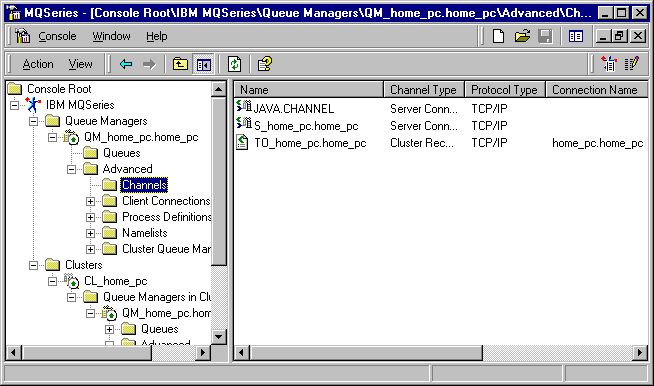
1. Create a new Server Connection Channel called 'JAVA.CHANNEL' on the Default Queue Manager
2. Develop the Sender/Receiver Applet
3. Build the project
4. Open up the HTML page and view the Applet
1. Create a new
Server Connection Channel called 'JAVA.CHANNEL' on the Default Queue Manager:
2. Develop the
Sender/Receiver Applet
The final code looks like this:
| MQApplet.java |
//******************************************************************************
// MQApplet.java:	Applet
//
//******************************************************************************

import java.awt.*;
import java.applet.*;
import java.awt.event.*;

// Include the MQ package
import com.ibm.mq.*;

public class MQApplet extends Applet
 implements Runnable, ActionListener {

 private Button btnCreateQ, btnOpenQ, btnSendMsg, btnRecvMsg;
 private Label labHName, labChannel, labQMgr;
 private TextField editHName, editChannel, editQMgr;
 private TextField editSendMsgText, editRecvMsgText;

 // define the name of your host to connect to
 private String m_hostname = "localhost";
 // define name of channel for client to use
 private String m_channel  = "JAVA.CHANNEL";
 // Note. assumes MQ Server is listening on
 // the default TCP/IP port of 1414
 // define name of queue manager object to connect to.
 private String m_qManager = "QM_home_pc.home_pc";

 MQQueue m_system_default_local_queue;
 // define a queue manager object
 private MQQueueManager m_qMgr;


 private Thread	 m_mqApplet = null;
 private boolean m_fStandAlone = false;

 public MQApplet() {
  // UI for the applet
  btnCreateQ=new Button ( "Create Q" );
  btnCreateQ.addActionListener(this);

  btnOpenQ=new Button ( "Open Q" );
  btnOpenQ.addActionListener(this);

  btnSendMsg=new Button ( "Send Msg" );
  btnSendMsg.addActionListener(this);

  btnRecvMsg=new Button ( "Recv Msg" );
  btnRecvMsg.addActionListener(this);

  labHName=new Label ( "Host Name:" );
  labChannel=new Label ( "Channel:" );
  labQMgr=new Label ( "Queue Manager:" );
  editHName=new TextField ( "localhost", 30 );
  editChannel=new TextField ( "JAVA.CHANNEL", 30 );
  editQMgr=new TextField ( "QM_home_pc.home_pc", 30 );
  editSendMsgText=new TextField ( "Test Message", 30 );
  editRecvMsgText=new TextField ( "", 30 );
 }

 public String getAppletInfo() {
  return "Name: MQApplet\r\n" +
         "Author: Gopalan Suresh Raj" +
         "Created with Microsoft Visual J++ Version 6.0";
 }

 public static void main (String []args) {
  MQApplet obj = new MQApplet();
  obj.init();
  obj.start();
 }

 public void init() {
  setLayout ( new GridLayout ( 3, 1 ));
  Panel p=new Panel();
  p.setLayout ( new GridLayout ( 3,2 ));
  p.add ( labHName );
  p.add ( editHName);
  p.add ( labChannel );
  p.add ( editChannel );
  p.add ( labQMgr );
  p.add ( editQMgr );
  add ( p );
  p=new Panel();
  p.setLayout ( new GridLayout ( 3, 2 ));
  p.add ( btnCreateQ );
  p.add ( btnOpenQ );
  p.add ( btnSendMsg );
  p.add ( editSendMsgText );
  p.add ( btnRecvMsg );
  p.add ( editRecvMsgText );
  add ( p );
  resize(600, 400);
 }

 public void destroy() {
  // TODO: Place applet cleanup code here
 }

 public void paint(Graphics g) {

 }


 public void start() {
  if (m_mqApplet == null) {
   m_mqApplet = new Thread(this);
   m_mqApplet.start();
  }
  // TODO: Place additional applet start code here
 }

 public void stop() {
  if (m_mqApplet != null) {
   try {
    // Close the queue
    m_system_default_local_queue.close();
    // Disconnect from the queue manager
    m_qMgr.disconnect();
   }
   // If an error has occured in the above, try to identify what went wrong.
   // Was it an MQ error?
   catch (MQException ex) {
    System.out.println("An MQ error occurred : Completion code " +
                       ex.completionCode +
                       " Reason code " + ex.reasonCode);
   }
   m_mqApplet.stop();
   m_mqApplet = null;
  }

  // TODO: Place additional applet stop code here
 }

 public void run() {
  while (true) {
   try {
    // TODO:  Add additional thread-specific code here
    Thread.sleep(50);
   }
   catch (InterruptedException e) {
    // TODO: Place exception-handling code here in case an
    //       InterruptedException is thrown by Thread.sleep(),
    //		 meaning that another thread has interrupted this one
    e.printStackTrace();
    stop();
   }
  }
 }


 public void actionPerformed(ActionEvent  evt) {
  if ( evt.getSource() == btnCreateQ )
   CreateQueue();
  else if ( evt.getSource() == btnOpenQ )
   OpenQueue();
  else if ( evt.getSource() == btnSendMsg )
   SendMsg();
  else if ( evt.getSource() == btnRecvMsg )
   RecvMsg();
 }


 private void CreateQueue() {

  try {
   // Set up MQ environment
   // Could have put the hostname & channel string directly here!
   MQEnvironment.hostname = editHName.getText();
   MQEnvironment.channel  = editChannel.getText();

   // Create a connection to the queue manager
   m_qMgr = new MQQueueManager(editQMgr.getText());
  }
  // If an error has occured in the above, try to identify what went wrong.
  // Was it an MQ error?
  catch (MQException ex) {
   System.out.println("An MQ error occurred : Completion code " +
                      ex.completionCode +
                      " Reason code " + ex.reasonCode);
  }
 }


 private void OpenQueue() {

  try {

   // Set up the options on the queue we wish to open...
   // Note. All MQ Options are prefixed with MQC in Java.

   int openOptions = MQC.MQOO_INPUT_AS_Q_DEF |
                     MQC.MQOO_OUTPUT ;

   // Now specify the queue that we wish to open, and the open options...

   m_system_default_local_queue = m_qMgr.accessQueue("SYSTEM.DEFAULT.LOCAL.QUEUE",
                                                     openOptions,
                                                     null,           // default q manager
                                                     null,           // no dynamic q name
                                                     null);          // no alternate user id
  }
  // If an error has occured in the above, try to identify what went wrong.
  // Was it an MQ error?
  catch (MQException ex) {
   System.out.println("An MQ error occurred : Completion code " +
                      ex.completionCode +
                      " Reason code " + ex.reasonCode);
  }
 }

 private void SendMsg() {

  try {
   // Define a simple MQ message, and initialise it in UTF format..
   MQMessage sendMsg = new MQMessage();
   sendMsg.writeUTF(editSendMsgText.getText());

   // specify the message options...
   MQPutMessageOptions pmo = new MQPutMessageOptions();  // accept the defaults, same
   // as MQPMO_DEFAULT constant
   // put the message on the queue
   m_system_default_local_queue.put(sendMsg,pmo);
  }
  // If an error has occured in the above, try to identify what went wrong.
  // Was it an MQ error?
  catch (MQException ex) {
   System.out.println("An MQ error occurred : Completion code " +
                      ex.completionCode +
                      " Reason code " + ex.reasonCode);
  }
  // Was it a Java buffer space error?
  catch (java.io.IOException ex) {
   System.out.println("An error occurred whilst writing to the message buffer: " +
                      ex);
  }
 }

 private void RecvMsg() {

  try {
   // get the message back again...
   // First define a MQ message buffer to receive the message into..
   MQMessage retrievedMessage = new MQMessage();
   //   retrievedMessage.messageId = hello_world.messageId;
   editRecvMsgText.setText ("");  // clear old text
   // Set the get message options..
   MQGetMessageOptions gmo = new MQGetMessageOptions();  // accept the defaults
   // same as MQGMO_DEFAULT

   // get the message off the queue..
   m_system_default_local_queue.get(retrievedMessage,
                                    gmo,
                                    100);              // max message size

   // And prove we have the message by displaying the UTF message text

   String msgText = retrievedMessage.readUTF();
   editRecvMsgText.setText (msgText);
   System.out.println("The message is: " + msgText);
  }
  // If an error has occured in the above, try to identify what went wrong.
  // Was it an MQ error?
  catch (MQException ex) {
   System.out.println("An MQ error occurred : Completion code " +
                      ex.completionCode +
                      " Reason code " + ex.reasonCode);
  }
  // Was it a Java buffer space error?
  catch (java.io.IOException ex) {
   System.out.println("An error occurred whilst writing to the message buffer: " +
                      ex);
  }
 }

}
|
4. Create the
HTML Code to View the Applet
| MQApplet.html |
<HTML> <HEAD> <META NAME="GENERATOR" Content="Microsoft Visual Studio 6.0"> </HEAD> <BODY> <P> </P><!-- Insert HTML here --><APPLET code=MQApplet.class height=200 name=MQApplet width=320> <PARAM NAME="foreground" VALUE="FFFFFF"> <PARAM NAME="background" VALUE="008080"> <PARAM NAME="label" VALUE="This string was passed from the HTML host."> </APPLET> </BODY> </HTML> |
5. Open up
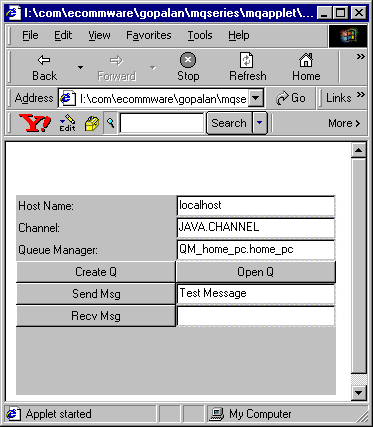
AppletViewer and run the applet
|
This site was developed and is maintained by Gopalan Suresh Raj This page has been visited
|
|
Last Updated : Feb 24, '99 |
||
Copyright (c) 1997-2000, Gopalan Suresh Raj - All rights reserved. Terms of use. |
All products and companies mentioned at this site are trademarks of their respective owners. |


.gif)